Tuesday, 1 December 2015

Everything begins with acceptance, everything ends with expectations.

Everything begins with acceptance, everything ends with expectations.

What do I mean my acceptance? Acceptance is being in nature with, in resonance, in harmony, in balance. There is no better or best, what is, is perfect. In every way. Know this, we are unique. Every stage of our evolution is perfect. The caterpillar to the butterfly and the process within is all required: every step is needed. Accelerate one stage, and you have chaos. The seed under the ground needs to harden before it sprouts: it must die unto itself before it transforms and is re-born.

A farmer was disappointed with nature that his crops would not grow as well as he would like, and for one season the Maker gave him the boon to control the climate. He ordered Sunny days, and wet days, but in the end the crops failed. It was the dry period that was so badly needed for the seeds to sprout. Life must be accepted in its eternity: not more of this, and less of that. Everything is needed. Everything, good and bad (not my words) is needed.

In child psychology it is well understood that as a child skips one stage (for example the crawling stage, as he uses a walker, his growth is slightly stunted). Our brains continue to retain all of our primordial selves: the amphibian, reptilian, etc even as we evolve. We are in a state of transition all the time. No step is to be missed.

Borrowed text below:

Love is made up of three unconditional properties in equal measure:

1. Acceptance
2. Understanding
3. Appreciation

Love is unconditional: it is given without any expecatations. It is giving completely. Like a a flower that blossoms before it bears fruit: it is our very nature to love.


“Life is a series of natural and spontaneous changes. Don't resist them; that only creates sorrow. Let reality be reality. Let things flow naturally forward in whatever way they like.” 
 Lao Tzu


“A friend is someone who gives you total freedom to be yourself-and especially to feel, or not feel. Whatever you happen to be feeling at any moment is fine with them. That's what real love amounts to - letting a person be what he really is.” 
 
Jim Morrison

Yet we are filled with expectations: all the time. We expect more from ourselves and from others around us. Expectations come from a notion of a false illusion that if this were to come true: we would be happy. Many of us pray with the belief that we expect we would live the good life eternally, worse still we expect to save ourselves from the agony of hell. Priests and Pundits create expectations.  Once we buy into that: we are imprisoned in their games. Then we can be controlled. Like Pavlov: conditioned, we salivate like the dog, hoping for the promised.

Regrettably, what we seek is a myth: a phantasy; what we have, we don’t not value at all, and what we want Nobody gives in the exact way we want. Even an ideal self is the worst poison: it is the most dangerous. It is a false exuberance and commitment around a goal that we hold most dear to ourselves, but which will forever endure.

Our expectations from ourselves come from Introjects of significant others in our lives: symbols of an elusive better self. All our lives, we expect more from ourselves: who we are is not good enough.


Remember this, expect and you will be disappointed, surely as night follows day. Accept, and nature bends unfolding her beauty in full panoply.

Sunday, 29 November 2015

Another perspective on Goals!

It is seductive to hang onto goals. It’s a game we humans play.

Goals that give meaning to our lives is a prayer, else it is an albatross!

Attach oneself to an inner purpose. Abandon measures and milestones. They do limit.

Research says that once you fix a goal you limit yourself. Take the Roger Bannister running bit. If you know it is under 4 minutes that sets the record in the mind and for years it will act as a constraint. Take the bumble bee. It is not aware of the laws of thermodynamic. Yet it does not know this and yet it flies.

In the end, to me, goals are like pieces on the chessboard. To many there are powerful like queens and knights. Yet, they are all wooden pieces and lie inert in the box when the game is over. All equal. All inert. All lifeless. All meaningless. Only in the game does the player gave it life. This is important to remember, that the chess pieces are portent or otherwise, only as per ‘rules defined and agreed’ and by the players, not by itself.

Alive within a goal is a deep purpose that needs to be understood. A desire to see a force of potential. It is only this that inspires and lifts.

When we truly tap that energy within a goal, then only can we and empower oneself.

Goals are like a 'Finance Plan' - it is a general direction. It is an assumption. it is a plan, it is a commitment to deliver. It is a path forward. it is indicative of progress. It is a jouney with stretch. At all times it must be remembered that this 'goal' was based on a foundation of - beliefs, assumptions, values, knowledge and desire to succeed. As such, rigidity to one's goal becomes a burden. At it best, a goal lifts us up, at its worst it imprisons us to a self slavery, or worse mortgaged to others. This must be understood. It becomes a 'duty'- then we no longer enjoy it - we do it mindlessly - as if it is the only thing we have to do.

i hear many people say, what to do this is my duty- so i do it. nonsense. one should do it only if one enjoys it, not otherwise. when one is aware of what one is doing, fully aware and enjoying what one is doing - then there is a goal.

A goal should be replaced by VISION - it is broader! A vision is a direction, like a sketch. when it becomes a clearly defined map, it is disenabling. it is like a globe, where Greenland appears larger than Australia, but one must know that it i an illusion ( Australia land mass is 3x greenland). Knowing that goals are itself a perspective, it allows one to traverse the path, with one's own experiences.

Tsu Lao, would have commented, there is no need to journey across to the shore. The shore opposite is here. The beginning exists with the end: the alpha with the omega. When one has a sense of one's full journey, through a vision of his own purpose, there is an inner light that drives him forward. he moves on his own violation - phototropicity, i think scientist call it. 


Then there is no need to travel: one moves only in the RIGHT path. One moves intuitively only in the correct ways. 

let me simplify: if one is a great batsman, he needs no targets! he just enjoys batting and is aware each moment. he plays to each ball, he is alive to each moment. then he knows what to do when a ball comes through: he knows what to do with a full length, good length or short pitch - he acts without targets. he acts only with a vision and purpose and values. he steps forward or back, or sideways. he moves all at once. the spectators do not see a bowler or a batsman: they see a display of genius.

when one is in flow, the actor, and the scene disappears - just the act remains, the dancers give way to the dance.  Then there is only the dance, no dancers at all.

Goals, when embraced , without pressure, but pleasure lifts; when taken on as 'desires' or obligations de-energise.

Also, one comes with the other- you cannot have one without the other.

Goals belong there - not here! Goals lies in the future: an expectation. A phantasy. Drop Goals: here is. It is here already. It has always been here. No need for a search - that is a desire. Drop the desire, drop the source of the desire, drop goals. This world here is real, with the other: an unreal, never to be realized.

When there is no goal, one relaxes: with nothing to do, the ego disappears. The 'I' disappears. 

Then acceptance, grace begins.....the bhagwan within unfolds....


Drop all goals! Stay aware!

So what's the alternate to Goals? Focus on systems instead. 


  • If you are a Coach, your Goal is to win the tournament, your System is what your team does at practice each day.
  • If you are a Writer, your Goal is to write a Book, your system is a writing schedule each day.
  • If you are a runner, your goal is to run the marathon, your system is your training schedule each day.
  • If you are an entrepreneur, your goal is to build a Million Dollar Business, your System is Sales and Marketing. 
We are all motivated by 'wins' and get depressed by 'losses'. Have milestones along the way, so that you feel you are moving towards something each day. Keep the milestone related to each day and celebrate the small wins. Alcoholic Anonymous focus on staying 'Alcohol Free' each day! That's measurable each day and wins or losses are easily measurable. 

The trick is not 'avoidance' ( like stop smoking), instead it is about, 'smoke free today'. 

Timothy Gallwey, in his book, 'The inner Game of Tennis' shares that we have two selves - Self 1 and Self 2. Self 1 is egoistic and tends to worry, while Self 2 is intuitive. He argues that one should allow for Self 2, and let the game be played by intuition and by the subconscious rather than with an outcome focus. And finally to discover the Self 3, a better human being. 

Friday, 28 August 2015

Leh Ladakh, erstwhile west Tibet, truly lives up to its moniker, 'roof of the world'.


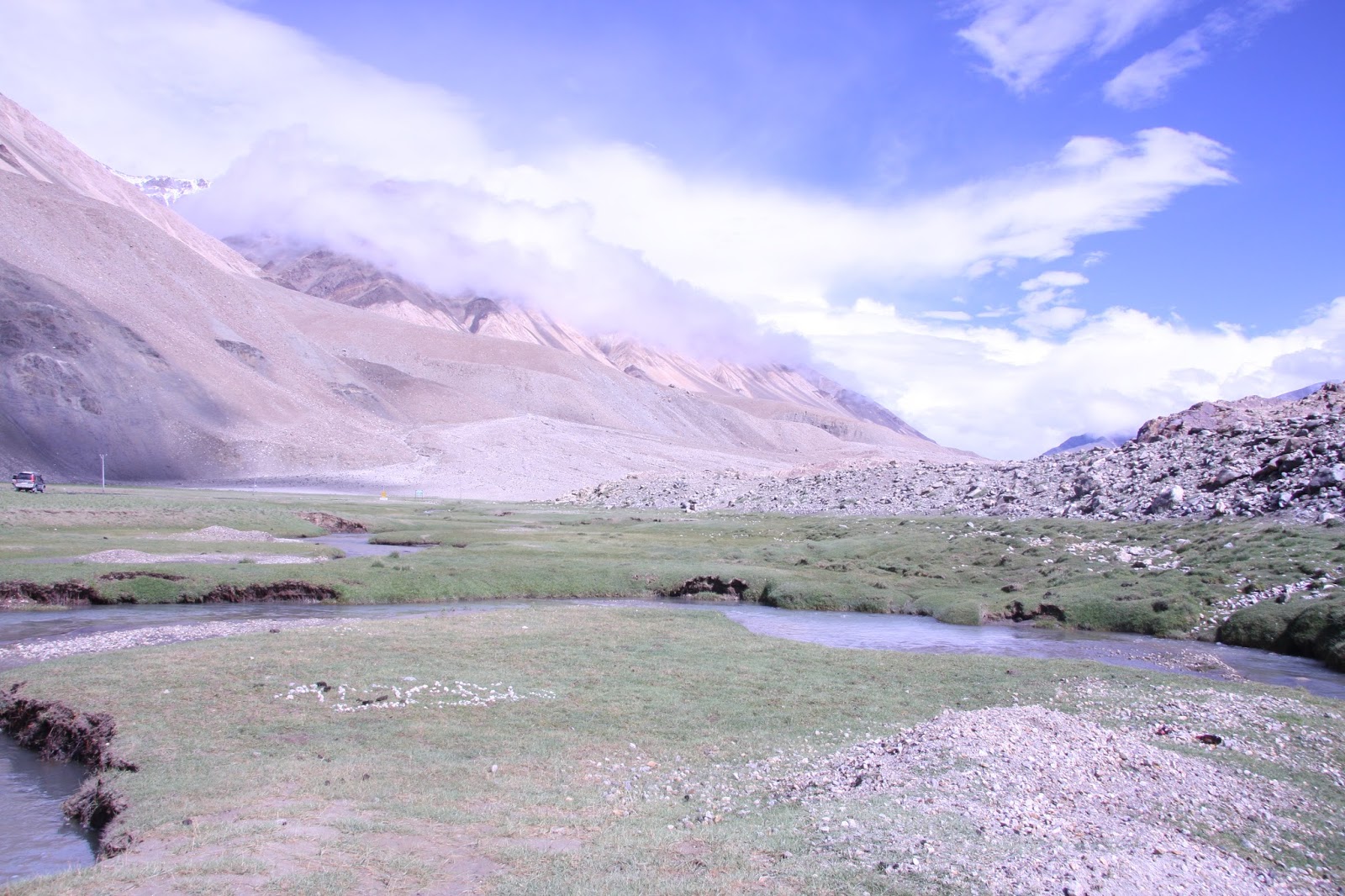
Atop an elevation of nearly 6000 metres , it is indeed one of the remotest, rugged and sparsely populated region in the world. The geography is mountainous with little or no vegetation, sparse cultivation, and absence of animal livestock, save a few Yaks, Marmuts and donkeys. 


This is indeed the cold desert, home to the Ladakis, with the tourist season open just between April to September, before the land is plunged into sheets of snow rest of the year.

To travel around Ladakh, one has to travel on roads cut across the sides of the mountain. The road are basic, and quickly damaged with clay and rubble that fall continuously from the mountain sides. Often with light rain, boulders fall across and block the roads. The absence of vegetation allows constant soil erosion. For several miles roads give way to dirt tracks, even worse rubble tracks and some tracks even submerged under running water streams that pass through.  


Driving on these roads are treacherous: on one side is the sheer drop to the valley below. On the other side are rock outcropping, blind spots and always, the roads are narrow just a few feet wide. Driving speed does not exceed 20 kms an hour, and driving speed drops to a crawl as cars pass each one by. For larger vehicles, one would have to halt completely, even as one would have to select a wider section, to allow a truck to pass. Loose gravel and dust on the road with occasional boulders always required the driver to be attentive at all times. These were roads that needed to be navigated and traversed carefully; certainly not just to be driven over.  

A drive to Nubra valley (and you have to pass the Khardungla Pass, the highest motorable road in the world! https://www.youtube.com/watch?v=GG1vNTelJGc
or to Pangong Lake, a distance of 120 kms would take around 5-6 hours. As always, it was bumpy and jerky all of the time. The temperature would be around 17 Celsius yet the sun rays would be harsh and the glare blinding requiring content use of sunscreen and UV protected sunglasses at all times.  Yet the wind was sharp and cold, at times biting cold. The air at these heights is thin and rarefied with less oxygen. Walking a few feet up a slope would have you breathless and gasping for air. It is not unusual to have bouts of nausea, headaches even in some cases occasional vomiting. For prolonged head aches the best cure would be to drive down to lower slopes Occasional patches of wild flower would dot the edges of the road, providing the only colour to the black winding bumpy roads, that crisscrossed the brown mountains, exposed most often to grey shale rock, as its frontal cover, would get shorn off. Once it snowed briefly, but thankfully just briefly, for a minute or two at maximum. That helped: the dust settled in, and the next few miles were pleasant.
.


Roads signs were few dotting the routes. Some provided the obvious caution: drive carefully.  One said: accidents hurt, safety does not . One said rather ominously, 'drive slowly to avoid grave below' I enjoyed one, on the way to the hot springs that proclaimed' drinking whisky makes driving risky' :) Mountains are a pleasure if you drive with leisure. Be soft to my curves

Far across the horizon enchanting as always were blue mountains in the distance as they nested below white clouds that seemed to only move imperceptibly and at moments casting its shadows on some of the mountain slopes. Occasional milestones signalled distances to the nearest village and flagged off the height: usually at 15500 feet and above. One is always driving up or down all the time.


Not born into this world, but born of it seems to be a constant reminder the past ten days. Truly, man is a part of nature, and must exist in true harmony with it. A short episode of taking refuge in a nomad's yak tent, on the way to Pangong made this point admirably well.  Here was a family that truly lived in the midst of nature and yet they seemed happy even though they had nothing except for a few meagre belongings of a few rugs, pot and pans, and a mobile stove. Yet food was always plentiful: thanks to the yaks milk that produced tea, butter and cheese. With roasted barley mixed with yogurt, a favourite food     


Even as we sat in the tent, it began to snow, but it was wam inside. Surprisingly, the yak hair tent kept the snow from entering inside. A Ladakhi couple, with a small child and the parents of one of them lived altogether.  Although, they had very little, their home was warm, inviting and cheerful. They offered everything they had, with the greatest of generosity, that would put a city dweller to shame.  When it stopped snowing and we moved off, they did accept the small contribution we made in cash.  

Living together in one tent, I was struck with the thought, how necessary it would be for all members to be sensitive to each other's needs at all times. I could see all five (even the little child) were very caring to each other. A relationship of love, care, nurturance, trust and communication. In our homes today, with separate living quarters, TV sets and books, how easy it seems for each one to be physically present but mentally absent.

[a sketch of the Stok peak across Saboo valley]


Visit to the monasteries


Quite recently, for some time I harbored the notion of taking a year's sabbatical to become a monk.  Frankly, I was disappointed with my visit to the monastery. Don't get me wrong it has nothing to do with the monasteries I visited: they were all beautiful, well maintained and informative. We visited the temple at Diskit, Hemis, Likir, and Alchi. 


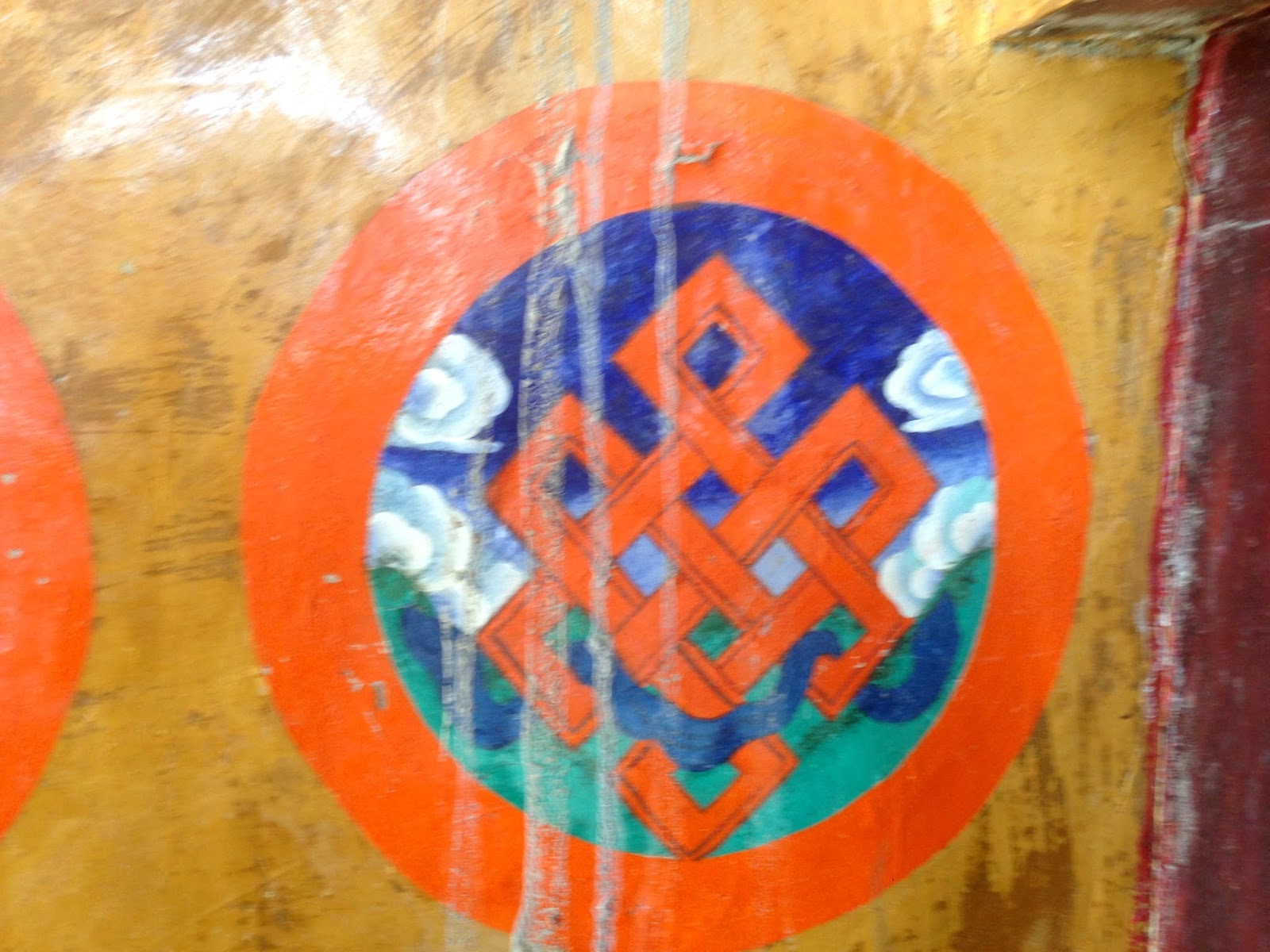
From a historical and cultural perspective it revealed in resplendent grandeur its glory! We saw stunning thanka paintings, images of all forms of Buddha: Maitreya Buddha and the bodyguards who watched over the four directions. Yet everything seemed anchored in the past, the stories of a generation gone by, and I who had come to see a living religion experienced only one which was presented in its narrative. For me it did not seem contemporary, aligned to my current reality. It was difficult to co-hold this past narrative with the current Prakriti of my distance. As a narrative it was rich, full some and replete with rich treasure.


The Buddhist monastic life is frugal, replete with routine, and disciplined, and in what many would consider to be harsh living environment.  The monks seemed content, to the life they choose. I heard that most novices enter the monastery at the age of 6- 9 years. 


 I saw many young boys: playful.  Yet I could sense, they were training to be more disciplined, restrained, watchful. Reading the Dalai Lama own autobiography, 'Freedom in Exile' I read with interest his own narrative of the disciplined life he had to undergo as a child in the monastery under his two tutors. As he himself admits, his childhood was not one similar to Siddartaha the prince, who was to eventually become the enlightened Sukyamuni Buddha.


For me it seems, that religion needs to be alive, relevant ever more to the present. It must provide the experiences in the ' here and now' to shape our thoughts, feelings and actions. It must ever mor tap into our own abundance of deep presence, for spontaneous actions and choices. It must stay away from knowledge, but tap into our own intuition. Through this intuitive journey, that is detached from the mind, and free from clouded emotions, that reality becomes apparent: who we are, our purpose, the nature of our inter connectedness. Only then do we recognise the impermanence of our being, that thee is no fixed reality, that everything is in a state of 'ammness' , everything is evolving, there is no beginning nor ending. That we are all with an atmic soul but from an overall Brahman consciousness. That I am that.


For me then, the notion of being part of the community, is a restriction. Our individualism calls us to realise our beings, yet we do so in the canvas of humanity. Be your own light unto yourself said Buddha. Then it seems to me, that any form of organised religion, is but empty rituals, practices, whose meanings have been lost in obscurity. Thus lies the unfamiliarity of the Vedas, giving way to the Upanishads.  


Truth is one. It existed then at the time of Abraham, as it exist today.  For when a master declares, I come before Abraham even, he is not referring to chronology of age.  

As is apparent, the two weeks I spent at Leh ladakh has been very meaningful: a real break away from what is the usual 'been there done that' kind of vacation. I have savoured every moment, both physically and emotionally.

The mountains and valleys and streams speak to those who can hear, but the messages go not to the ears but to the heart!  


Sunday, 9 August 2015

Two Birds on a Tree - A tale from Manduka Upanishad

Adam and Eve: The forbidden fruit

In the Genesis of the Old Testament lies the story of Adam and Eve, wherein God forbids that from the ‘tree of knowledge’ its fruit shall not be eaten. Eve ate first  (when Adam hesitated) and later he followed. With this, they were both banished from Paradise.

Quite similar, is the Upanisadic story (as told in the Manduka Upanishad) of the Pippala tree (representing the body), where two birds are perched, one (Jivatman, or individual self) who has eaten the fruit (sensual pleasure), and the other(Paramatman) who watches the first. The Upanishad eloquently describes the two birds: the former who has achieved Jiva (the individual self) and the other the Supreme reality, who knows himself as the Atman. 

Religious and philosophical truths have been shared through stories and parables. Through them rituals are performed to preserve this truth, but if the meanings are understood the ritual is not necessary, I would argue. Then, and now, this just points to one fact: the presence of a Universal Religion: one truth.


[Ram Nidumolu, someone who I met recently, wrote a book: Two Birds in a Tree, where he expounds on the story, and through his summary ‘tweets and seeds’ section provides pointers on lessons for Business Leaders].